
(updated October 26th, 2026)
A dry cappuccino has more foam and less steamed milk. A wet cappuccino has more steamed milk and less foam. The espresso is the same in both, so “wet” and “dry” only tell the barista how to split the milk.
The name trips a lot of people up, so it’s worth saying plainly: dry doesn’t mean less foam. It means more of it, because the foam counts as the “dry” part of the cup compared with the liquid milk underneath.
The Whole Scale At A Glance
The scale runs from bone dry, which is all foam, to super wet, which is nearly all milk. None of these terms has an official recipe behind it, though the regular cappuccino does: the Istituto Espresso Italiano specifies 25 ml of espresso and 100 ml of milk, but it doesn’t say how that milk splits between liquid and foam, and that split is exactly what wet and dry change. So read this as the shape of the scale rather than a set of measurements.
| Order | Steamed milk | Foam | What you notice |
|---|---|---|---|
| Bone dry | None | Fills the cup | Espresso under a thick cap of foam |
| Dry | Less than usual | Deep, stiff layer | Lighter cup, coffee further forward |
| Regular | Some | About 1 to 2 cm | The balance the drink was built around |
| Wet | More than usual | Thin, silky layer | Creamier and sweeter, closer to a latte |
| Super wet | All or nearly all | None or almost none | Barely a cappuccino any more |
What Is A Dry Cappuccino?
A dry cappuccino is a regular cappuccino with more of its milk turned into foam. The cup is the same size and the shot is the same, but less liquid milk goes in, and a deeper layer of stiff foam sits on top.
The extra foam changes how the drink tastes. Breville describes the thicker foam as staying separate from the milk and espresso below it, which gives the drink more structure and lets the espresso taste stronger. There’s no extra caffeine, though. The coffee just has less milk to get lost in.
Going dry has two side effects worth knowing. A dry cappuccino has fewer calories than a regular one, because foam is mostly air and the milk it replaces isn’t. And if what you really want is less foam, dry is the wrong word to use: ordering a cappuccino without foam gets you closer to a latte.
What Is A Wet Cappuccino?
A wet cappuccino goes the other way: more steamed milk and a thinner layer of foam. The milk and foam blend into the espresso rather than sitting on it, so the drink is creamier, sweeter and milder.
Wet foam is also the kind latte art needs. Barista Hustle, which trains baristas, puts the decline of very foamy cappuccinos down to that: you can’t pour a design with dry foam. Push wet far enough and it stops being a cappuccino at all. Nescafé says a “super-wet” one, with no foam left, “starts to resemble a flat white more than a cappuccino”.
If that’s where you’re heading, it’s simpler to order the drink you’re picturing by name. Here’s how a latte differs from a cappuccino, and how a flat white does.
What Is A Bone Dry Cappuccino?
A bone dry cappuccino is espresso topped with foam and nothing else. Nescafé describes it as all foam, with none of the liquid milk a regular cappuccino has. It’s the far end of the scale: a cappuccino-sized cup of foam, with no liquid milk to soften the coffee underneath.
“Extra dry” is the term to be careful with, because it has no standard meaning. It can mean bone dry, or something just short of it, mostly foam with a splash of milk. So if the difference matters to you, say what you want in plain words: “foam only, no steamed milk” or “mostly foam, a little milk”.
Is Bone Dry Just A Macchiato?
Close, but no. Both are mostly espresso and foam, which is why Nescafé calls bone dry “slightly similar to a macchiato”. The difference is how much there is. Starbucks describes an espresso macchiato as espresso “marked with a dollop of steamed milk and foam”, so a spoonful of milk and foam on top of a shot. A bone dry cappuccino is a cappuccino-sized drink, so the same shot sits under a great deal more foam.
So a macchiato is mostly coffee with a mark of foam, and a bone dry cappuccino is mostly foam with coffee underneath. Same idea, very different amounts. The full side-by-side, including the latte and caramel versions, is in macchiato vs cappuccino.
Where Did “Wet” And “Dry” Come From?
Starbucks did the most to spread them. According to Barista Hustle, as the chain spread at the end of the 1990s it let customers customize every drink, wet or dry included. Dry meant aiming for about equal parts milk and foam. Wet meant less than 5 mm of foam on a latte.
American cappuccinos used to be far foamier than they are now. Todd Carmichael of La Colombe told the Seattle Times that the cappuccino at Torrefazione Italia, an influential Seattle café, had foam so thick “you could set an olive on it and it wouldn’t sink”. Latte art changed that, because it needs silky, pourable milk, and Barista Hustle notes that even the regular cappuccino is less foamy than it once was.
Italy has its own way of asking. At Cibrèo Caffè in Florence, TASTE found locals asking for a cappuccino con molta schiuma (with lots of foam), con meno latte (with less milk) or senza schiuma (without foam). There’s more on how cappuccino is made and ordered in Italy if you’re heading there.
How To Order One
Say the style, then add a few plain words, because neither term comes with a fixed recipe and two cafés can pour the same order differently:
- Bone dry: “a bone dry cappuccino, foam only, no steamed milk”
- Dry: “a dry cappuccino, extra foam”
- Wet: “a wet cappuccino, light foam”
At Starbucks the menu doesn’t use the words at all. On the cappuccino’s own page the foam setting runs Extra Foam, Foam, Light Foam and No Foam, so Extra Foam is roughly the dry end and Light Foam roughly the wet end. If you order in the app, those are the settings to look for.
One bit of courtesy: bone dry asks the most of the barista, because it takes a lot of foamed milk to fill a cup with foam alone. Maybe not one for the morning rush.
Making It Dry Or Wet At Home
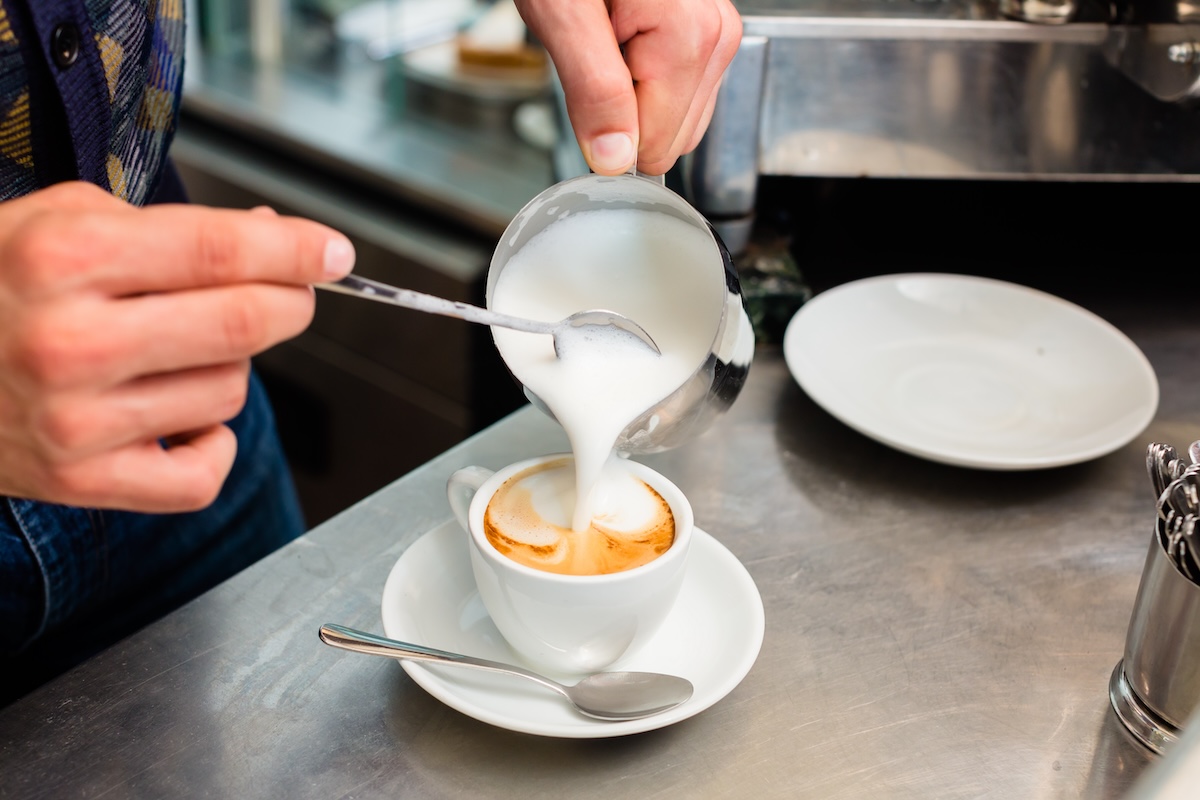
At home, the good news is that dry is the easier of the two to get right. Breville makes the point that a dry cappuccino doesn’t need the careful pour, because the foam is layered on with a spoon. Wet is the one that takes practice, since the milk has to be smooth enough to blend in as it pours.
For a dry cappuccino with a steam wand:
- Pull your shot into the cup.
- Steam the milk with the wand tip near the surface for longer than usual, so it takes on more air and gets thick.
- Hold the foam back with a spoon and pour a little of the liquid milk into the espresso.
- Spoon the foam on top to fill the cup. For bone dry, skip the liquid milk and use foam only.
For wet, do the opposite: add air only briefly at the start, then sink the tip so the milk spins into a smooth, glossy texture, and pour it straight in. How long to steam the milk covers the timing, and what good cappuccino foam looks like covers the texture. No machine? Making a cappuccino without an espresso machine works for both.
Which Should You Order?
If cappuccinos usually taste too milky to you, go dry. If they taste too strong or too stiff, go wet. That’s most of the decision, and it’s an easy one to test, since the only thing that changes is the milk.
I’d try dry before bone dry, though. Bone dry takes away the liquid milk completely, and that milk is what softens the espresso and carries its sweetness. Dry keeps a little of it and still gives you the big foam cap.