
(updated August 25th, 2026)
A cappuccino has foam because the foam is what makes it a cappuccino. Take the layer away and you are holding a different drink, which is why the standards specify a foam depth and specify almost nothing else about the milk.
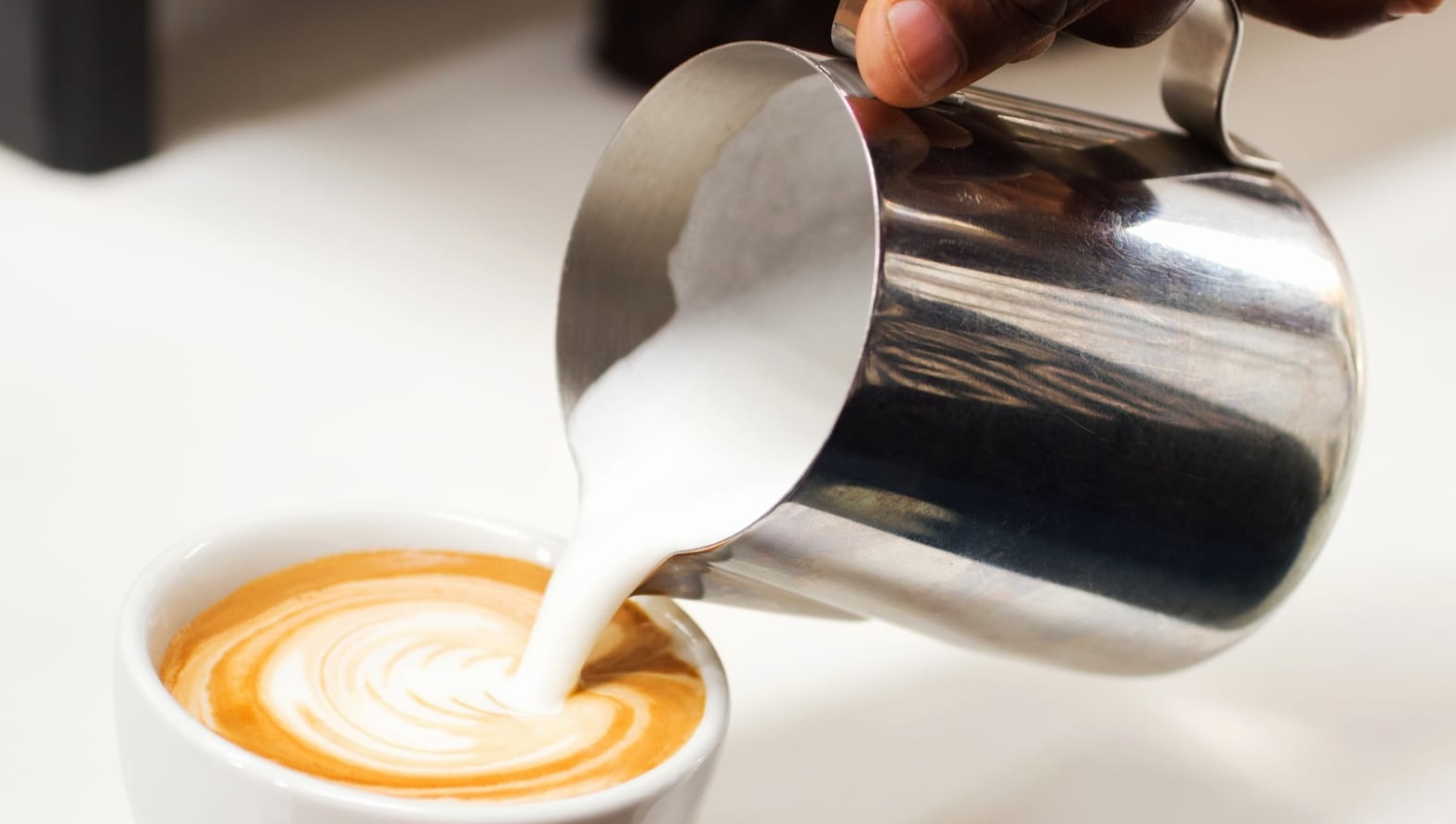
The foam isn’t a third ingredient sitting on top of two others, either. It’s the same milk you pour, with air worked into it as it steams.
What Is Cappuccino Foam Made Of?
Milk and air, and nothing else. Steaming drags air into the milk and the milk’s own proteins hold the bubbles up. That’s the whole trick. Pour 100 ml of cold milk into a jug, steam it properly, and you get roughly 125 ml of the same milk with air in it, which is where the extra volume in the cup comes from.
The Istituto Espresso Italiano puts a cappuccino at 25 ml of espresso to 100 ml of milk. There is no separate line in that recipe for foam, because there was never a third thing to pour.
How Much Foam Should A Cappuccino Have?
Around a centimetre at minimum, and a bit more if you are being taught properly. Carmen Clemente, the 2022 World Latte Art Champion, told Perfect Daily Grind that “the cappuccino requires at least 1cm of microfoam”. Melissa Caia, who runs the William Angliss Institute’s Coffee Academy, gave the teaching standard to the Sydney Morning Herald as “two centimetres for a cappuccino, one centimetre for a caffe latte, and minimal foam on a flat white”.
Notice what that measurement is doing. Foam is set as a depth, not as a share of the drink, which is a different kind of rule from the ratios people usually quote.
Can You Order A Cappuccino Without Foam?
You can ask, and a barista will make you something. What you won’t get is a cappuccino, because the foam is the part that makes it one.
It’s also worth knowing that none of the standard milk drinks is actually foamless. By Caia’s figures a caffe latte still carries about a centimetre and a flat white carries minimal foam, which is not the same as none. So the honest answer to “what is a cappuccino without foam called” is that it’s closest to a latte, and you’ll get a better drink by ordering that by name than by asking for a cappuccino with a part taken out.
What Is A Dry Cappuccino?
The opposite of what the name suggests to most people. A dry cappuccino has more foam and less steamed milk, not less foam. You get a stiffer, airier drink with the coffee further forward, because there’s less liquid milk in there to dilute it. A wet cappuccino is the reverse: more steamed milk, less foam, heading towards a latte.
So if what you want is less foam, “dry” is the wrong word to ask for. It will get you more. Going dry also cuts the calorie count, for the same reason: air weighs nothing and the milk it displaces does.
Is A Cappuccino Mostly Foam?
No, and it’s a reasonable thing to think, because the foam is the only part you can see. The drink underneath is 25 ml of espresso and 100 ml of milk, and the foam is the top centimetre or two of that, not the bulk of the cup. The volumes are worked through here if you want the arithmetic.
A cappuccino that really is mostly foam is a badly made one. That’s usually too much air worked in too early, which gives you a stiff, bubbly cap that sits up like meringue instead of a dense layer that pours.