

(updated August 29th, 2026)
A cappuccino and a latte usually contain the same amount of espresso. The difference is the milk: a cappuccino is a small drink with a thick cap of foam, and a latte is a much larger one with far more steamed milk and only a thin layer on top.
That catches most people out, because a cappuccino tastes noticeably stronger. It isn’t carrying more coffee. It’s carrying less milk, so the espresso has less to hide behind.
How Do A Cappuccino And A Latte Compare?
Size is the difference you notice first. A cappuccino is served in a small cup you can wrap a hand around. A latte turns up in something close to twice the volume.
| Cappuccino | Latte | |
|---|---|---|
| Typical size | 150 to 180 ml (5 to 6 oz) | 236 to 340 ml (8 to 12 oz) |
| Espresso | 1 shot, sometimes 2 | 1 to 2 shots |
| Foam depth | at least 1 cm | about 0.5 cm |
| How it reads | espresso forward, distinct layers | milder and milkier, mixed through |
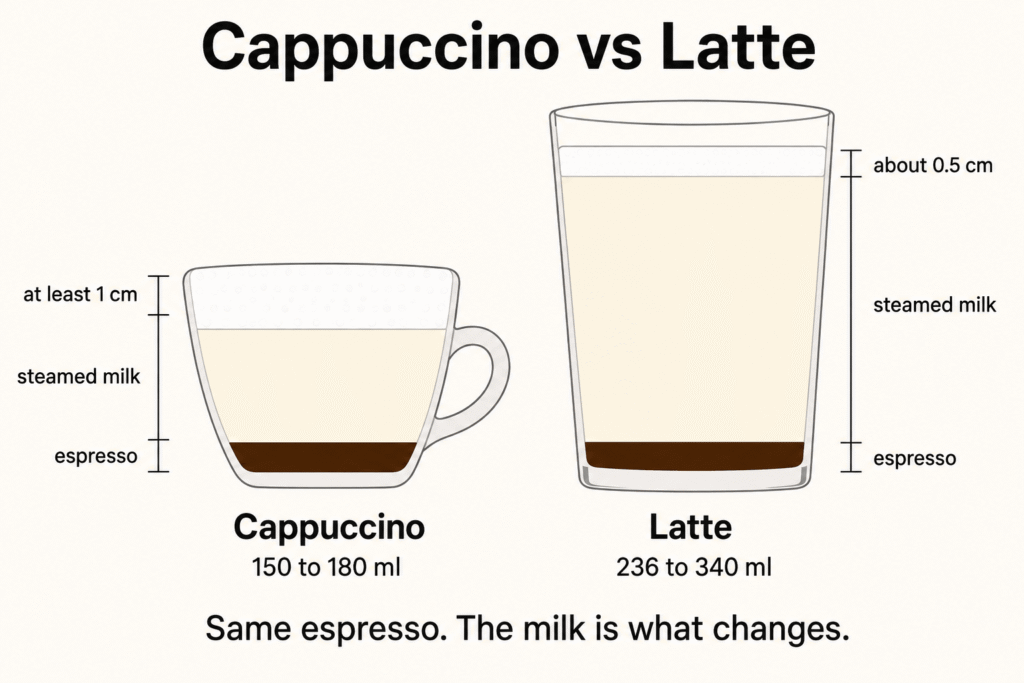
Those cappuccino figures are the Specialty Coffee Association’s current definition: a 150 to 180 ml drink built on a single shot, with at least a centimeter of microfoam. The same piece puts a modern latte at 236 to 340 ml with roughly half a centimeter of foam.
Which One Is Stronger?
A cappuccino tastes stronger. A large latte often holds more caffeine. Those are two different questions, and the answer flips depending on which one you’re asking.
On the espresso itself, the two drinks start level. Both are built on the same base, and plenty of cafes pull an identical shot for each. Where a shop scales up, it’s the larger drink that gains the second shot, so a big latte can carry more caffeine than a traditional cappuccino even though it tastes milder.
So the strength you taste isn’t a coffee measurement, it’s a dilution one. A cappuccino puts roughly a single shot into 150 ml of cup. A latte puts the same shot into up to twice that, and most of the extra is liquid milk. Same coffee, more to get through.
This is also why the old “equal thirds” description of a cappuccino doesn’t survive contact with the actual recipe. The certified Italian version is 25 ml of espresso to about four times as much milk, which we go through properly in how many ml is a cappuccino.
How Much Foam Should Each One Have?
A centimeter for a cappuccino, about half that for a latte. Foam depth is the most reliable way to tell them apart in the cup, more so than size, because cup sizes drift between cafes and countries while the texture does not.
Carmen Clemente, the 2022 World Latte Art Champion and co-founder of the World Latte Art & Coffee Center in Milan, is firm about it: “I think it is right to have rules. The cappuccino requires at least 1cm of microfoam.”
That difference is made at the steam wand rather than in the cup. Both drinks use milk taken to the same 60 to 65°C; the barista spends longer letting air into the jug for a cappuccino. If you want the mechanics, that’s covered in how long do you steam milk for a cappuccino.
It also explains the serving glass. A latte’s thin foam pours flat and holds a pattern, which is why latte art turns up on one and a plain domed top on the other.
Where Does A Flat White Fit In?
Between the two, and closer to the cappuccino. A flat white is usually built on a double shot in a cup the size of a cappuccino’s, with the thin foam of a latte, which makes it the most coffee forward of the three. We go through it properly in the difference between a cappuccino and a flat white.
Which One Should You Order?
Order a cappuccino when you want to taste the coffee and a latte when you want a longer, milkier drink. That’s the decision in one line, and it holds whatever the cafe calls its sizes.
Two things worth knowing before you do. If you’re ordering for the caffeine, ask how many shots are going in rather than going by the size of the cup, because the cup is the one thing that doesn’t tell you. And if a cappuccino arrives large with a shallow top, you’ve effectively been handed a latte with chocolate on it, because the foam is what makes it a cappuccino.