
(updated October 26th, 2026)
A macchiato has far less milk than a cappuccino. In its original Italian form it’s a shot of espresso with a spoonful of foam on top, while a cappuccino pours about 100 ml of steamed, foamed milk over the same shot.
The catch is that “macchiato” now names three different drinks, and depending on where you order, you might be handed something smaller than a cappuccino or a much bigger, sweeter drink. Here’s how to tell them apart.
One Word, Three Drinks
“Macchiato” covers three drinks: an espresso with a dab of foam, hot milk marked with espresso, and Starbucks’ sweet caramel version. The word is Italian for “stained” or “spotted”, as Lavazza puts it, and what gets stained with what is where they split:
| Drink | What it is | Size | Sweetened by default? |
|---|---|---|---|
| Espresso macchiato | Espresso marked with a dollop of milk foam | About 3 oz traditionally | No |
| Latte macchiato | Hot frothed milk marked with espresso | Often a tall glass | No |
| Caramel macchiato | Starbucks’ sweet, latte-style take | 8 to 24 fl oz | Yes |
| Cappuccino, for comparison | Espresso under steamed milk and a thick layer of foam | 25 ml espresso + 100 ml milk (Italian spec) | No |
The cappuccino figure is the Istituto Espresso Italiano spec, the Italian benchmark. The 3 oz for a traditional macchiato comes from Sprudge, and the Starbucks figures further down are a different yardstick again.
What’s The Difference Between A Macchiato And A Cappuccino?
The amount of milk. Both start with the same shot of espresso, but a cappuccino adds about 100 ml of milk, foamed, and a traditional macchiato adds a spoonful. Starbucks’ own definitions make the gap plain: an espresso macchiato is “espresso marked with a dollop of steamed milk and foam”, while a cappuccino is “espresso and steamed milk topped with a thick layer of foam”.
How much is a dollop depends on where you are. Mark Prince of CoffeeGeek describes the Italian macchiato as an espresso “marked” with a dollop of frothed milk “and nothing else”, while a North American specialty café is more likely to serve roughly equal parts espresso and pourable foam. Either way it’s a much smaller drink than a cappuccino, and the coffee is front and center in a way it isn’t in a cappuccino.
If you like the idea of a cappuccino with more coffee coming through, there’s a halfway house: a dry cappuccino keeps the cup size but swaps some of the milk for foam.
Is A Macchiato Stronger Than A Cappuccino?
It tastes stronger, but it usually has the same caffeine. The caffeine comes from the espresso, and the milk adds none, so the same shot gives you the same dose whichever drink it ends up in. What changes is how much milk there is to soften the taste, and an espresso macchiato has barely any.
Starbucks shows this neatly. A grande cappuccino and a grande Caramel Macchiato are both listed at 150 mg of caffeine. Same coffee, same dose. For the figures behind a regular cup, see how much caffeine is in a cappuccino.
Latte Macchiato vs Cappuccino
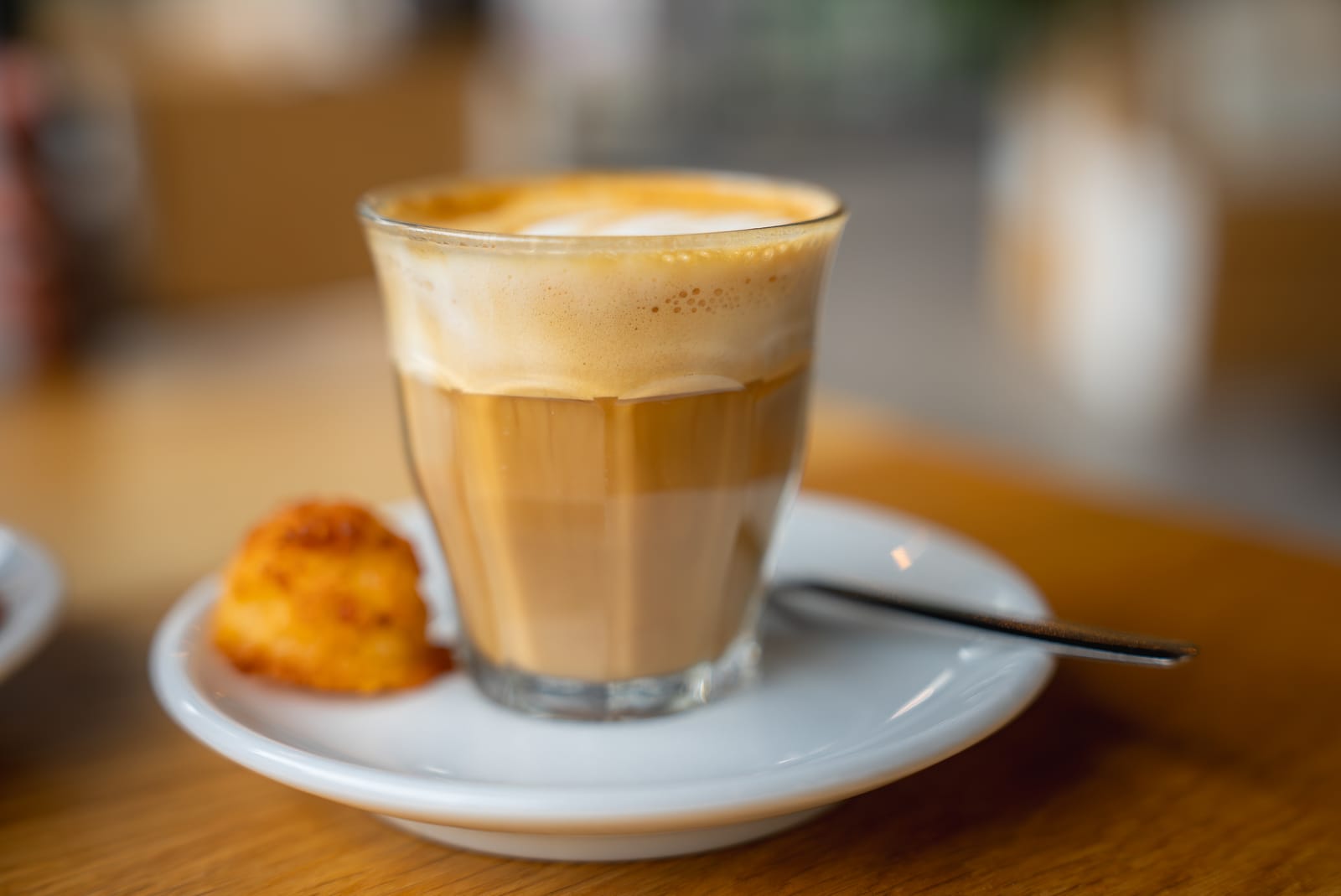
A latte macchiato turns the idea around: instead of milk marking the espresso, the espresso marks the milk. La Cimbali, the Italian espresso machine maker, says the name “literally means ‘stained milk'”, and its recipe is one espresso and 130 ml of hot frothed milk, with the milk poured first and the coffee poured in after.
One clear difference from a cappuccino is that order: in a cappuccino the milk goes onto the coffee. A latte macchiato is usually served in a tall glass, which shows off the layers. It’s also the milkier of the two, closer to a latte than to an espresso macchiato.
What About The Starbucks Version?
The Caramel Macchiato is a sweet, latte-style drink built the latte macchiato way round. Starbucks describes it as “freshly steamed milk with vanilla-flavored syrup marked with espresso and topped with a caramel drizzle”. Liz Clayton at Sprudge calls it “a latte-style beverage” and dates it to 1996.
Here’s how a grande compares with a grande cappuccino, using Starbucks’ own US nutrition pages for the Caramel Macchiato and the cappuccino:
| Grande (16 fl oz) | Calories | Sugars | Caffeine |
|---|---|---|---|
| Caramel Macchiato | 250 | 33 g | 150 mg |
| Cappuccino | 140 | 12 g | 150 mg |
The caffeine matches. The extra sugar comes from the vanilla syrup and caramel sauce: the cappuccino’s only ingredients are milk and espresso, so its 12 g is the milk’s own natural sugar, with nothing added. There’s more on that in how much sugar is in a cappuccino and how many calories are in one.
Latte, Cappuccino Or Macchiato?
Put the three classic drinks side by side and it comes down to milk. Starbucks sums each up in a line: a latte is “espresso balanced with steamed milk and a light layer of foam”, a cappuccino has “a thick layer of foam”, and an espresso macchiato is just “marked with a dollop”.
- Latte: the most milk and the least foam, so the mildest of the three.
- Cappuccino: less milk and a deep layer of foam, so the coffee comes through more.
- Espresso macchiato: barely any milk, so it’s mostly espresso.
If it’s the latte and cappuccino you’re weighing up, this side-by-side goes into sizes and milk amounts properly.
Ordering One Without A Surprise
Because one word covers three drinks, say which one you mean. Asking for just “a macchiato” can go wrong in either direction, which is why Barista Magazine suggests baristas reply by asking whether you want “a traditional macchiato, espresso with a touch of foam, or a bigger, sweeter drink”. “Espresso macchiato” or “caramel macchiato” settles it before anyone has to ask, though sizes still vary from café to café.
Italy has its own wrinkle. The same article says a macchiato there can mean either espresso marked with a touch of foam or steamed milk marked with espresso, so “caffè macchiato” or “latte macchiato” is the clearer way to ask. There’s more on ordering coffee in Italy if you’re heading there.
Which Should You Order?
If you drink espresso and want it a little softer, have an espresso macchiato. If you want something to sit with for a while, have the cappuccino. And if what you’re after is the sweet one from Starbucks, that’s a much sweeter drink, with more than twice the sugar of a grande cappuccino, which is fine as long as you know it going in.
If you’re a cappuccino drinker curious about a macchiato, I’d try the espresso version first. It’s the clearest way to taste what the milk in your usual cup has been doing all along.