
(updated August 18th, 2026)
Yes. A cappuccino is built on espresso, so unless you’ve asked for decaf there’s caffeine in it, and a standard single-shot cappuccino lands at roughly 63 to 75mg. That’s the whole answer for most cups. The bit worth knowing is that the number tracks the shots, not the size of the cup, which is why two cappuccinos that look nothing alike can carry exactly the same caffeine.
How Much Caffeine Is In A Cappuccino?
The USDA puts espresso at 212mg of caffeine per 100g, which works out at about 63mg in a 30ml shot. Starbucks lists 75mg for a Tall cappuccino, also a single shot. So 63 to 75mg is a fair working range for one shot, and the spread just reflects how much coffee goes into the basket and how it’s pulled.
Milk and foam add nothing. They make the drink bigger without making it stronger, so a small cappuccino and a large one built on the same single shot carry identical caffeine. The larger sizes at the chains are the exception, because that’s where a second shot usually appears. The two-shot rows below are worked out from the single-shot figures rather than published separately.
| What you ordered | Espresso shots | Caffeine |
|---|---|---|
| Traditional cappuccino, 150-180ml | 1 | about 63mg |
| Starbucks Tall, 12oz | 1 | 75mg |
| Starbucks Grande or Venti | 2 | about 150mg |
| Any double-shot cappuccino | 2 | about 126 to 150mg |
If you want the shot counts in more detail, I’ve broken those down in how many shots go in a cappuccino.
Does A Cappuccino Have Less Caffeine Than Coffee?
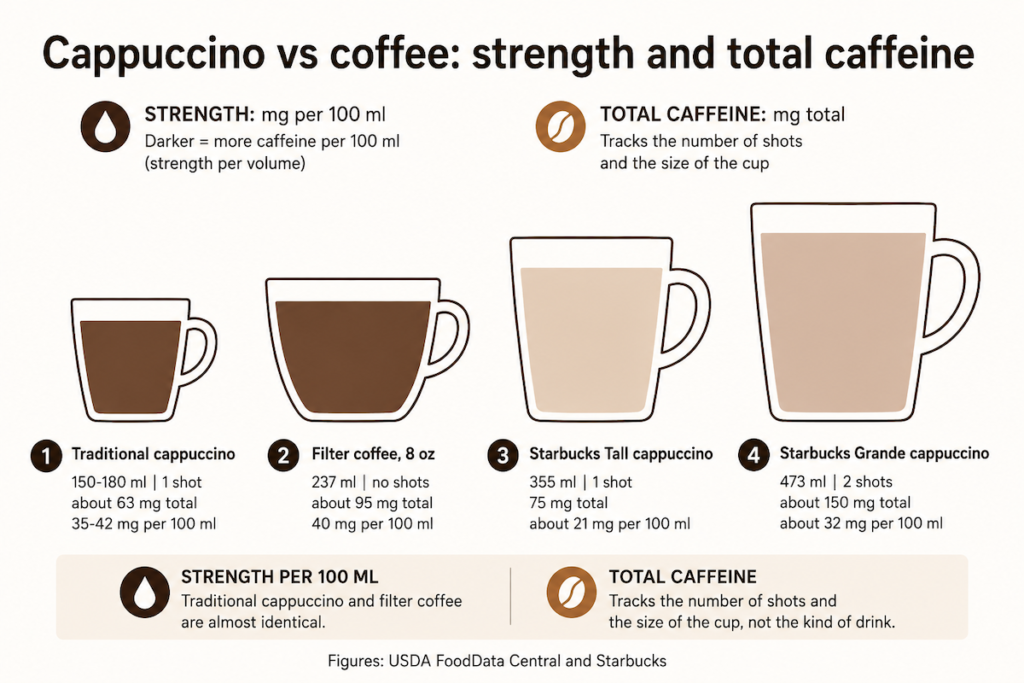
Not by strength, and this is the part most answers get backwards. The USDA’s figure for ordinary brewed coffee is 40mg per 100ml. A traditional cappuccino puts about 63mg into 150 to 180ml, which lands somewhere between 35 and 42mg per 100ml. Measured the same way, they’re the same drink. That second figure is worked out from the two USDA entries rather than published as such.
So a cappuccino isn’t weaker coffee. It’s usually just a smaller serving of it. An 8oz filter coffee comes to roughly 95mg and a 12oz to about 142mg, both above a single-shot cappuccino, and that’s entirely down to there being more liquid in the cup.
Chain cappuccinos push the other way. A Starbucks Tall spreads one shot across 12oz, so it works out at roughly 21mg per 100ml, noticeably more dilute than filter coffee even though the total is in the same neighborhood. It’s the same pattern that turns up on the calorie question: the popular answer usually isn’t wrong, it’s describing a different sized drink.
One caveat on the sources. Both USDA figures come from SR Legacy, a dataset retired in 2018 and no longer updated. Comparing them against each other is sound, because it’s the same dataset and the same method on both sides. Treat them as good reference points rather than a reading off your particular cup.
What Changes The Caffeine In Your Cup
Four things, in order of how much they matter:
- The shot count. One shot or two is the only change that moves the number much, and everything else on this list is a rounding error next to it.
- Whether it’s real espresso at all. Sachets, machine cappuccinos and instant mixes are built from coffee powder rather than a pulled shot, and they generally come in lower. That’s covered by drink in the gas station, cappuccino mix, French vanilla and Hills Bros pages.
- The beans. Robusta carries meaningfully more caffeine than arabica, and cheaper blends lean on it harder. More on that in arabica or robusta for cappuccino.
- Decaf. Worth saying plainly: decaf isn’t caffeine-free. The process removes most of it, not all of it, so a decaf cappuccino still has a trace.
Roast level gets raised a lot and belongs near the bottom of any list like this. The difference between a light and a dark roast is real but small, and it’s swamped by everything above.
Is 75mg A Lot Of Caffeine?
At 63 to 75mg, one cappuccino is a modest dose. The FDA’s guideline for healthy adults is 400mg a day, so a single cup sits comfortably inside it and you’d need five or six to reach that ceiling. The FDA frames 400mg as roughly two to three 12oz cups of coffee, which lines up neatly with a 12oz filter coffee landing near 142mg.
Timing does more work than quantity here, and I’ve gone into that properly in does cappuccino keep you awake. If you’re comparing it against an espresso rather than a coffee, is espresso stronger than a cappuccino is the one you want.
Which Should You Order?
If you’re trying to keep caffeine down, count shots and ignore the cup size. That’s the one rule worth taking away, and it’s the opposite of what the sizing on a menu board suggests. A single-shot cappuccino in a big cup is a milder drink than a small filter coffee, which comes in around 71mg for a 6oz cup.
And if you’re ordering a large cappuccino specifically because you want the caffeine, check whether you’re getting a second shot. Plenty of places just add more milk.