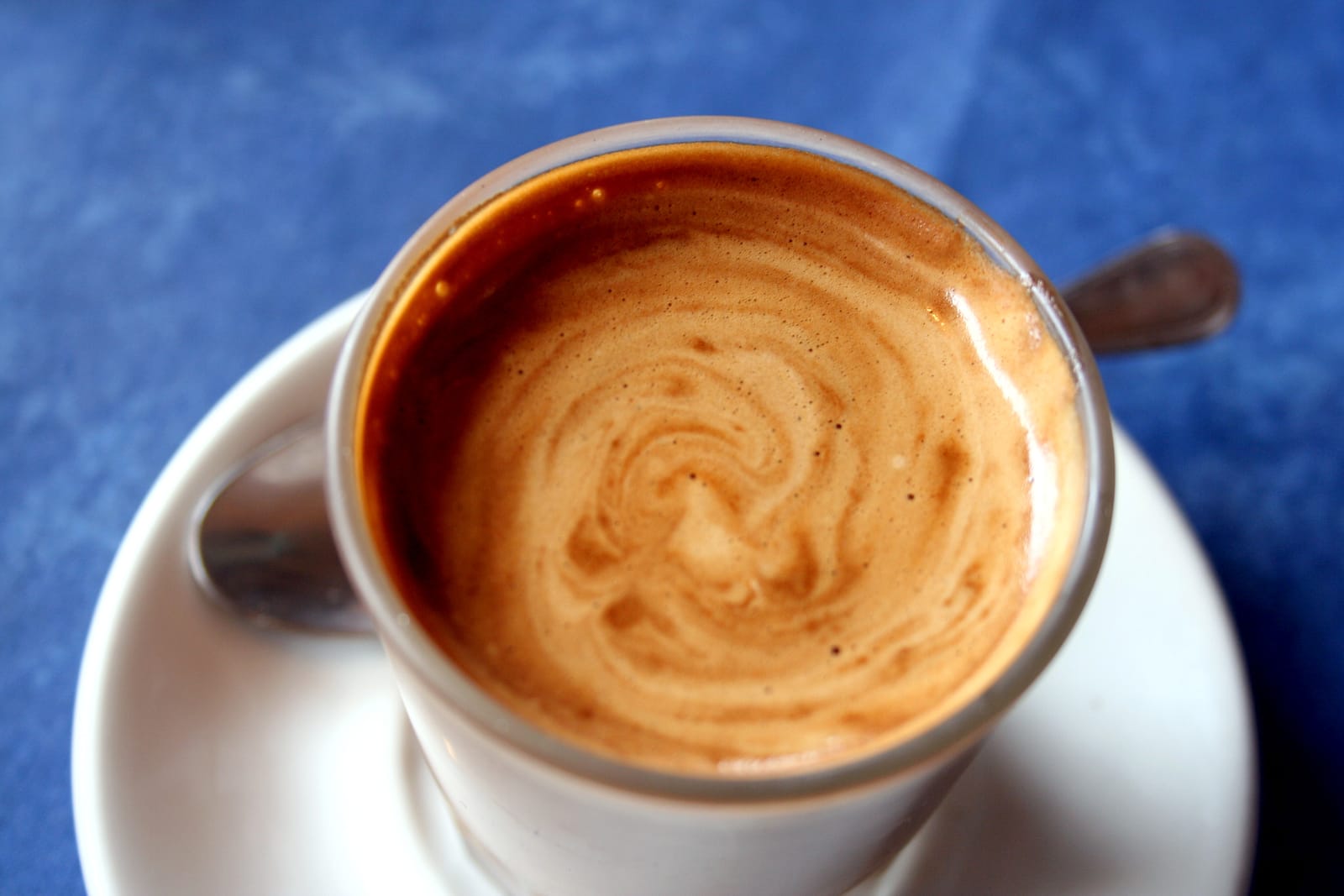

(updated November 2nd, 2026)
The difference is how much milk goes in. A cortado is roughly equal parts espresso and warm milk, about 4 oz in all, with little or no foam. A cappuccino puts about four times as much milk as espresso over the shot and tops it with a deep layer of foam. So a cortado tastes much more of the coffee, while a cappuccino is softer, creamier and a little bigger.
If you’re a cappuccino drinker eyeing a cortado on the menu, picture your usual cup with most of the milk taken out and the foam cap left off. That’s close.
What Is A Cortado?
A cortado is a Spanish espresso drink: espresso “cut” with about the same amount of warm milk. The name comes from the Spanish verb cortar, to cut, because the milk cuts the espresso’s bitterness without burying it. Writing in Barista Magazine, Eddie Gomez traces the drink to Spain’s Basque region and puts the usual serving at about 4 ounces.
The milk is the part people get wrong. Gomez describes it as “slightly steamed but not to the point where much texture is created”, so a cortado shouldn’t arrive with the thick foam you’d expect on a cappuccino. Liz Clayton at Sprudge places it neatly: in milk volume it’s smaller than a cappuccino and larger than a macchiato.
You’ll also see it under other names. In the US you may see it called a Gibraltar, named for the 4.5 oz Libbey glass it was first served in at Blue Bottle Coffee in the Bay Area in the mid-2000s. Gomez adds the Australian piccolo and the French noisette as near equivalents. The Cuban cortadito is a different thing, though: Sprudge describes it as sweetened espresso with steamed condensed milk.
Cortado vs Cappuccino, Side By Side
A cortado is about 1 part espresso to 1 part milk, roughly 4 oz in all. A cappuccino is about 1 to 4, in a 5 to 6 oz cup, with much more foam. The cappuccino figures below come from the Istituto Espresso Italiano, which specifies 25 ml of espresso and 100 ml of steamed milk (I’ve worked that out as a ratio), and from the Specialty Coffee Association’s 5 to 6 oz cup, as reported by Perfect Daily Grind. The cortado figures are Barista Magazine’s.
| Cortado | Cappuccino | |
|---|---|---|
| Espresso to milk | About 1 to 1 | About 1 to 4 |
| Usual espresso | Double shot | Single shot (Italian spec) |
| Size | About 4 oz (120 ml) | 5 to 6 oz cup (150 to 180 ml) |
| Milk | Steamed lightly, not stretched into foam | Steamed and foamed |
| Foam | Little | A deep layer on top |
| Comes from | Spain | Italy |
Size is the smaller gap: the Italian recipe’s 25 ml of espresso and 100 ml of milk come to 125 ml, not far off a cortado. It’s the split inside the cup that changes everything. Four parts milk to one of coffee, with a thick layer of foam on top, drinks very differently from half and half.
Which Is Stronger?
It tastes stronger, and it often has more caffeine, but only because of the espresso that goes into it. Milk adds no caffeine. A 4 oz cortado works out at a double shot. Barista Ruben Pablo puts it simply in Barista Magazine: “A double shot of espresso is roughly 2 ounces, so an equal amount of milk puts you at 4 ounces.” The Italian cappuccino spec is a single 25 ml shot.
Order a double cappuccino and the caffeine evens out. The taste won’t, because the cortado’s coffee is only softened by an equal splash of milk rather than four times as much. For the numbers behind a regular cup, see how much caffeine is in a cappuccino.
How It Compares With A Flat White, Latte And Macchiato
All of these are espresso and milk, and what separates them is how much milk and how much foam. From least milk to most:
- Espresso macchiato: a shot marked with a little milk, about an ounce according to Sprudge. More in macchiato vs cappuccino.
- Cortado: equal parts espresso and warm milk, about 4 oz, little foam.
- Flat white: usually a double shot like the cortado, but in a 5 to 6 oz cup, so more milk, with a thin layer of foam worked through it. More in cappuccino vs flat white.
- Cappuccino: usually a single shot in the same size cup, with a deep cap of foam.
- Latte: the biggest and milkiest, with a light layer of foam. More in latte vs cappuccino.
So asking for a large cortado doesn’t really work. “There are no mini or large versions of a cortado,” Gomez writes, and if you want more milk you’re better off ordering a latte or a cappuccino.
What Is The Starbucks Cortado?
Starbucks added a cortado to its US menu in January 2025, and it comes in a cup twice the size of the traditional 4 oz. Starbucks says it’s made with three ristretto shots of Blonde Espresso and steamed whole milk, served hot and only in the 8 oz short cup. A ristretto shot uses the same amount of ground coffee as a regular shot with less water, which Starbucks says gives a sweeter, richer flavor.
Here’s how it compares with a grande cappuccino, using Starbucks’ own US nutrition pages for the cortado and the cappuccino:
| Starbucks | Cup | Calories | Sugars | Caffeine |
|---|---|---|---|---|
| Cortado | Short, 8 fl oz | 90 | 6 g | 230 mg |
| Cappuccino | Grande, 16 fl oz | 140 | 12 g | 150 mg |
Half the cup, but about 50% more caffeine, which fits its three shots. Both drinks list only milk and espresso as ingredients, so the sugar comes from the milk. The flavored versions add syrup on top: the Brown Sugar Oatmilk Cortado, for one, uses brown sugar syrup and oat milk.
Which Should You Order?
Order the cortado if you like the taste of espresso and want it rounded off rather than smothered. It’s gone in a few minutes, and of the milk drinks it’s one of the closest to tasting like the shot itself. Order the cappuccino if you want something creamy to sit with, or if the foam is half the point for you. And if your usual cappuccino has started to feel a bit milky, I’d try a cortado first, or a dry cappuccino if you’d rather keep the foam.