
(updated November 5th, 2026)
Yes. A cappuccino has more than enough caffeine to keep you awake, and it stays with you longer than most people expect.
A single-shot cappuccino carries somewhere around 63 to 75 mg of caffeine. Almost all of it is absorbed within 45 minutes, levels in your blood peak anywhere from 15 minutes to two hours after you drink it, and half of it is still in your system about five hours later.
How Long Does A Cappuccino Keep You Awake?
Longer than the four-to-six-hour figure you’ll see repeated everywhere, and that figure is based on a misreading.
Caffeine’s half-life in a healthy adult is approximately five hours. Half-life is the time your body takes to clear half the dose, not all of it. So a 75 mg cappuccino at 3pm leaves you with roughly 37 mg at 8pm and about 19 mg at 1am. Caffeine tails off gradually, it doesn’t switch off at the five hour mark.
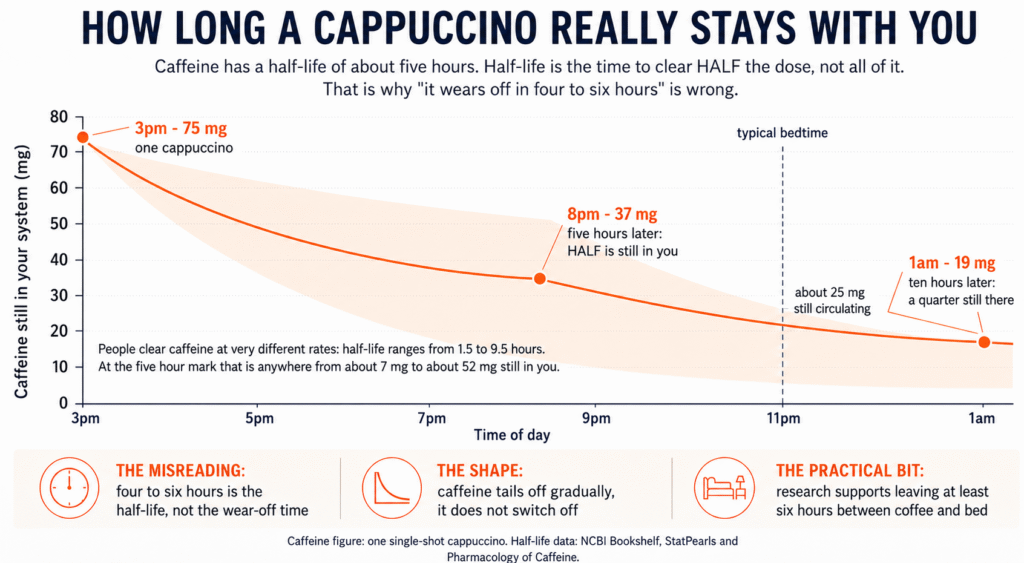
How long it affects you varies enormously between people. The half-life can run anywhere from 1.5 to 9.5 hours, shifting with your genes, pregnancy, the contraceptive pill and smoking. The pill can double it. Smoking works the other way: in smokers the half-life is up to 50% shorter, so they can clear caffeine up to twice as fast. That spread is why one person can have an espresso after dinner and sleep soundly while someone else is still staring at the ceiling at 2am.
Does It Affect Your Sleep?
Yes, even at the dose in an ordinary coffee.
Caffeine works by blocking adenosine receptors. Adenosine is the molecule that builds up through your waking hours and produces the feeling of tiredness. Caffeine blocks the signal, so you stop feeling sleepy, but the underlying sleep pressure keeps building. You’re muting the alarm, not resetting it.
It also moves your body clock. A 2015 study in Science Translational Medicine found that a caffeine dose equivalent to a double espresso, taken three hours before bed, delayed the body’s melatonin rhythm by about 40 minutes. That’s nearly half the delay caused by sitting under three hours of bright light at bedtime.
How Long Before Bed Should You Stop Drinking Cappuccino?
At least six hours. A cappuccino any closer to bedtime is likely to cost you some sleep, and one in the evening nudges your body clock later as well as keeping you alert.
The six-hour figure comes from a 2013 study in the Journal of Clinical Sleep Medicine, which gave people caffeine at bedtime, three hours before and six hours before. All three disrupted sleep compared with a placebo. It used 400 mg, about five or six cappuccinos, so treat it as proof that timing matters rather than a measure of one afternoon coffee. If you clear caffeine slowly, give yourself longer.
And if you get the cappuccino itch at 5pm, which I do more often than I’d care to admit, decaf is the answer. You keep the espresso flavor, the texture and the foam, and lose the part that keeps you up. It isn’t completely caffeine-free, there’s always a trace left in it, but it’s a small fraction of what’s in the regular version.