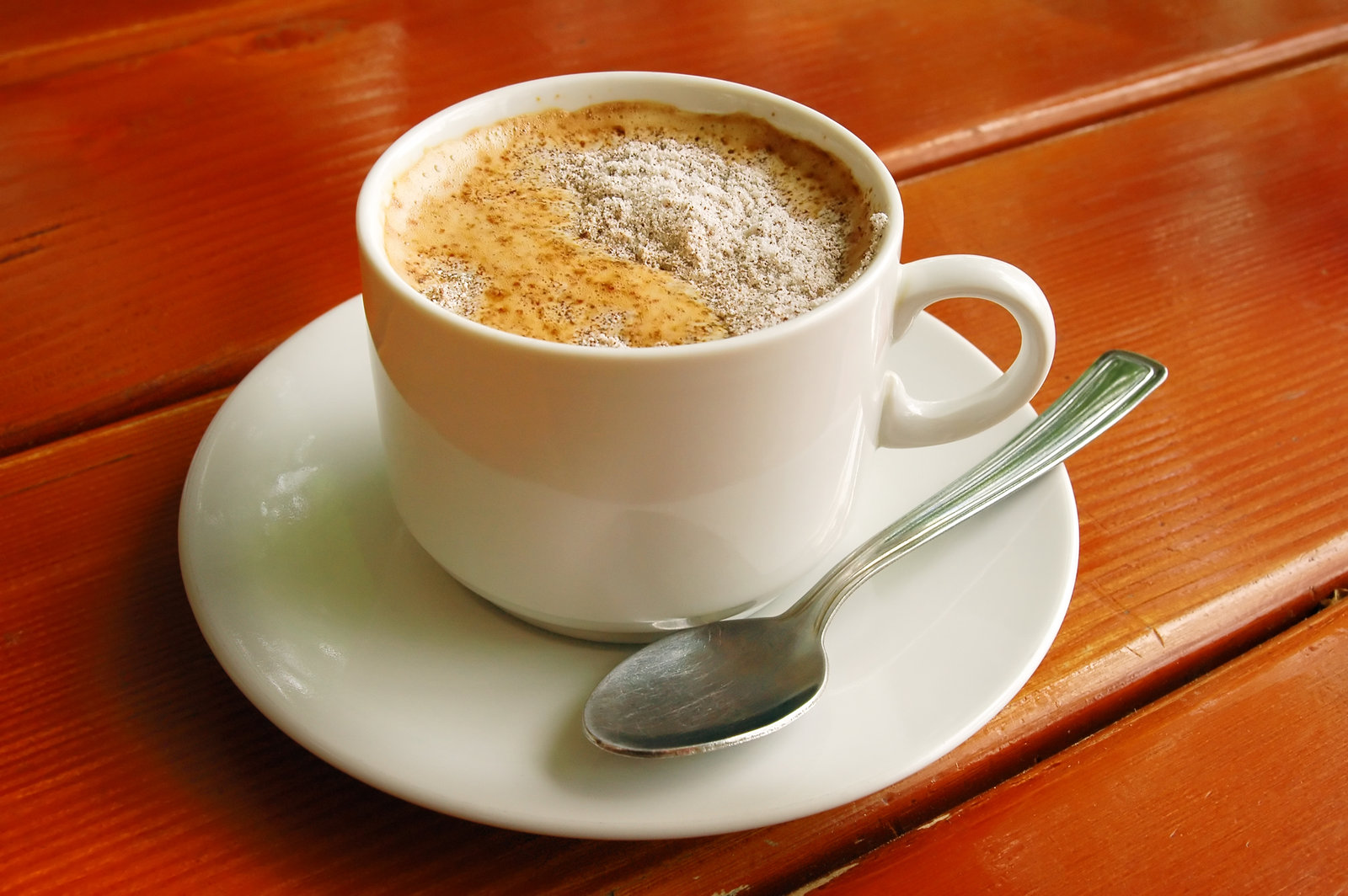

(updated October 19th, 2026)
No. A cappuccino counts toward your fluids much like a glass of water does, and the milk in it may help you hold on to that fluid slightly longer. Caffeine can make you pee more, but only at doses well above one cup, and mostly in people who don’t usually have it.
That’s not just reassurance. Nobody has tested a cappuccino as such, but coffee and milk have each been measured against water, and neither came out worse.
Is Coffee A Diuretic?
Only at high doses. Caffeine is a mild diuretic, but the dose matters more than the label. A review of the research by Maughan and Griffin found that large doses, “at least 250-300 mg”, give a short-term rise in urine output in people who’ve gone without caffeine for days or weeks. In regular coffee drinkers that effect is “much diminished”, because the body builds up a strong tolerance to it. And at the amounts in normal servings of tea, coffee and soft drinks, they found caffeine appears “to have no diuretic action” at all.
Put that next to a cup. A single-shot cappuccino carries about 63 mg of caffeine, so 250 to 300 mg is four or five of them in one go. One cappuccino isn’t in that range, and a regular drinker wouldn’t feel much even if it were.
Worth saying, because you’ll see it around: a diuretic makes you pee more. That on its own doesn’t hydrate you, so “coffee hydrates you because it’s a diuretic” gets the reasoning backwards, even though coffee doesn’t dehydrate you either.
What Happened When Coffee Was Tested Against Water?
Nothing, which is the point. In a University of Birmingham study, 50 men who normally drank three to six cups a day spent three days drinking four 200 ml cups of coffee, and another three days drinking the same amount of water instead. Their total body water came out at 51.5 kg on coffee and 51.4 kg on water, and their 24-hour urine at 2,409 ml against 2,428 ml. None of the blood or urine measures of hydration differed between the two.
The authors’ conclusion was that coffee, in moderation, “provides similar hydrating qualities to water”. The limits are worth knowing: everyone in it was male and already used to caffeine, which is exactly the group the tolerance finding above would predict to be least affected.
Does The Milk Make A Difference?
If anything, it helps. A trial led by Ronald Maughan at Loughborough University gave 72 men a liter of one of 13 common drinks and measured how much of it they’d peed out over the next four hours. Coffee was no different from water. Milk was better than water: after four hours, water had produced 1,337 g of urine, whole milk 1,052 g and skim milk 1,049 g.
From that the researchers built a beverage hydration index, which scores each drink by how much of it you’re still holding two hours later, with water set at 1. Here’s where the drinks relevant to a cappuccino landed:
| Drink (1 liter) | Compared with water |
|---|---|
| Water | 1.00 (the baseline) |
| Coffee | No different from water |
| Whole milk | 1.50 |
| Skim milk | 1.58 |
Don’t stretch this too far. A cappuccino has about 100 ml of milk in it, not a liter, so the milk isn’t turning it into a sports drink. What it does show is that the milk is working with you, not against you.
Does A Decaf Cappuccino Dehydrate You?
No, and it has even less reason to. Decaf isn’t completely caffeine-free, but the FDA puts decaf coffee at “2 to 15 milligrams in an 8-fluid-ounce cup”. That’s a small fraction of a regular shot, and nowhere near the doses that showed any effect on urine at all. Even the top of that range is less than a sixteenth of the 250 mg where the effect starts.
Why Does Coffee Make You Pee?
After a large dose, especially if you don’t usually drink caffeine, the short-term urge is real: that’s the effect the Maughan and Griffin review describes. But peeing more for a few hours isn’t the same as losing more fluid than you drank. The same review found no support for the idea that caffeinated drinks, as part of a normal routine, lead to “fluid loss in excess of the volume ingested”.
Can You Count A Cappuccino Toward Your Fluids?
Yes, I’d count it, and not because it’s a clever loophole. The evidence just doesn’t support treating it as a drink that cancels itself out. If you’re having enough cappuccinos for the caffeine to matter, the number worth watching is the FDA’s 400 mg a day for most adults, which is about six single-shot cappuccinos. You’d hit that well before hydration became the problem.