
(updated August 7th, 2026)
A traditional cappuccino is made with a single shot of espresso, roughly 25 to 30 ml. That’s the whole coffee component. Everything else in the cup is milk and the foam that comes with it.
Plenty of cafes pour two, particularly in the larger cups you’ll find outside Italy, and that’s where most of the confusion on this question comes from. And yes, in case it’s the actual question you came with: the coffee in a cappuccino is espresso, not brewed coffee.
How Many Shots Are In A Cappuccino?
One, in the traditional recipe. The Italian Espresso National Institute, which certifies the drink in its home country, specifies 25 ml of espresso to 100 ml of milk. The World Barista Championship defines a shot of espresso as around 1 fl oz, or 30 ml. Both are describing a single shot.
Cup size is what changes the answer. A traditional cappuccino is only about 150 ml in total, so one shot is plenty. Once a cafe is filling a 12 oz or 16 oz cup, that single shot has a lot more milk to carry, so a second usually goes in to keep the coffee tasting like coffee rather than warm milk.
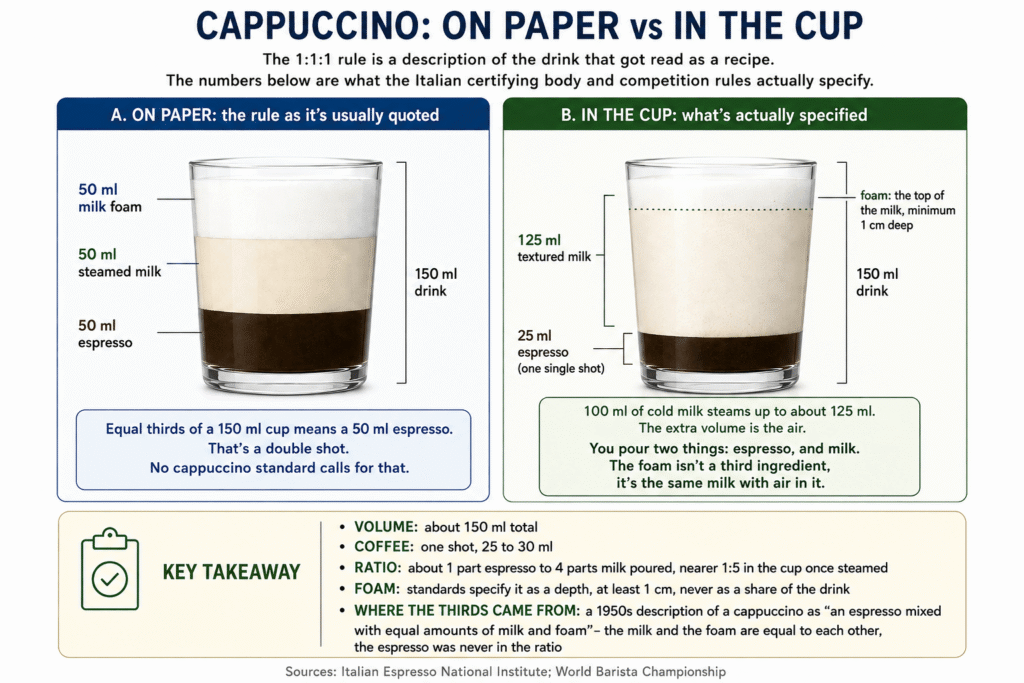
You may also have run into the rule that a cappuccino is equal parts espresso, steamed milk and foam. It doesn’t hold up, and it’s the source of a lot of inflated shot counts: a third of a 12 oz cup would be 4 oz of espresso, which is three or four shots and far more than anyone pours. The real ratio is closer to one part espresso to four parts milk. As per this infographic highlighting how it looks on paper, compared to ‘in the flesh’.
Is A Cappuccino A Single Or Double Shot?
Traditionally a single. The certified Italian recipe uses one 25 ml shot, and the World Barista Championship’s milk beverage rules require a minimum of one shot, not two.
Doubles are common in practice though, and there’s nothing wrong with one. It comes down to what you do with the milk. Add a second shot and keep the milk the same, and you get a stronger, more coffee-forward drink in the same size cup. Add a second shot and scale the milk up with it, and you’ve essentially made a bigger cappuccino rather than a stronger one.
It matters if you’re counting caffeine. USDA FoodData Central puts espresso at 212 mg of caffeine per 100 g, which works out at roughly 63 mg in a 30 ml shot. So a single-shot cappuccino lands near 63 mg and a double near 126 mg.
Individual coffee shops run higher or lower than that, because caffeine depends on the bean, the dose and the roast rather than on the volume alone. Starbucks, for one, puts its own espresso at 75 mg a shot. So treat 63 mg as a reasonable middle figure rather than a fixed number.
How Many Shots In A Starbucks Cappuccino?
Fewer than most people expect. A Starbucks cappuccino gets one shot in the two smaller sizes and two in the larger ones:
| Size | Espresso shots | Caffeine |
|---|---|---|
| Short (8 oz) | 1 | not listed separately |
| Tall (12 oz) | 1 | 75 mg |
| Grande (16 oz) | 2 | about 150 mg |
| Venti (20 oz) | 2 | about 150 mg |
The 75 mg for a Tall comes straight from Starbucks’ own nutrition information. The Grande and Venti figures are that same single-shot number doubled, since both carry two shots.
So a Tall is a single shot, not the two or three people often assume from the size of the cup. I checked the US and UK versions of that page and both list the same shot counts and the same 75 mg for a Tall, so it holds on either side of the Atlantic. It’s worth a local check elsewhere, since Starbucks uses different beans in different regions and the caffeine figure moves with them.
So How Many Shots Should You Use?
Match the shot to the cup. At home in a 150 ml cup, a single is the right call. The bigger the cup, the more likely a second shot belongs in it, and if you’re ordering out you’re probably getting one anyway.