
(updated October 13th, 2026)
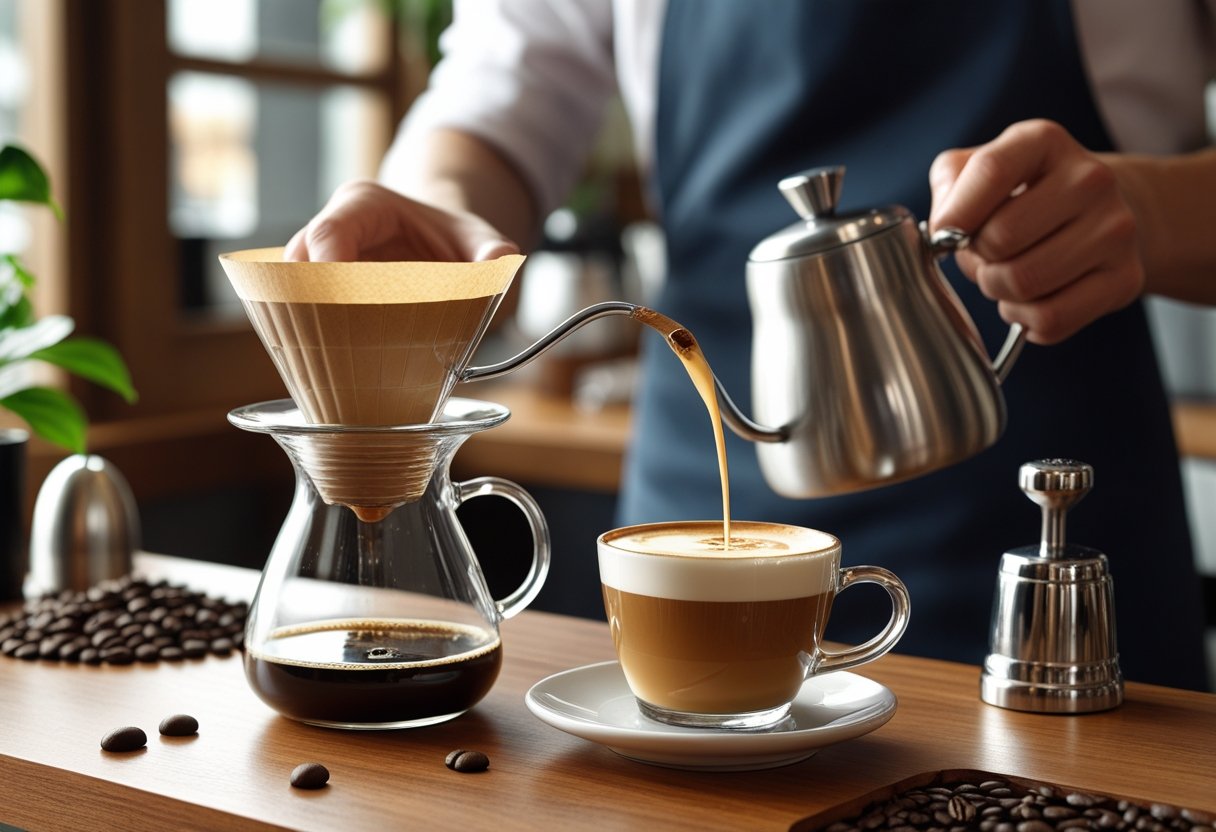
You can make a cappuccino-style drink with a pour-over, but not a true cappuccino. Pour-over makes filter coffee, which is far weaker than espresso, so the trick is to brew a small, extra-strong cup and keep the milk to a cappuccino’s proportions. It’ll taste like a rich, milky coffee rather than a café cappuccino, and it’s still a good one.
How do you make a cappuccino with a pour-over?
Brew less coffee than usual, much stronger than usual, and froth the milk separately:
- Use about twice your normal amount of coffee for the water. A normal pour-over runs at 1 part coffee to 14 to 16 parts water, according to Methodical Coffee. There’s no standard recipe for a milk drink, so treat this as a starting point: 20 g of medium-fine ground coffee to about 160 g of water just off the boil.
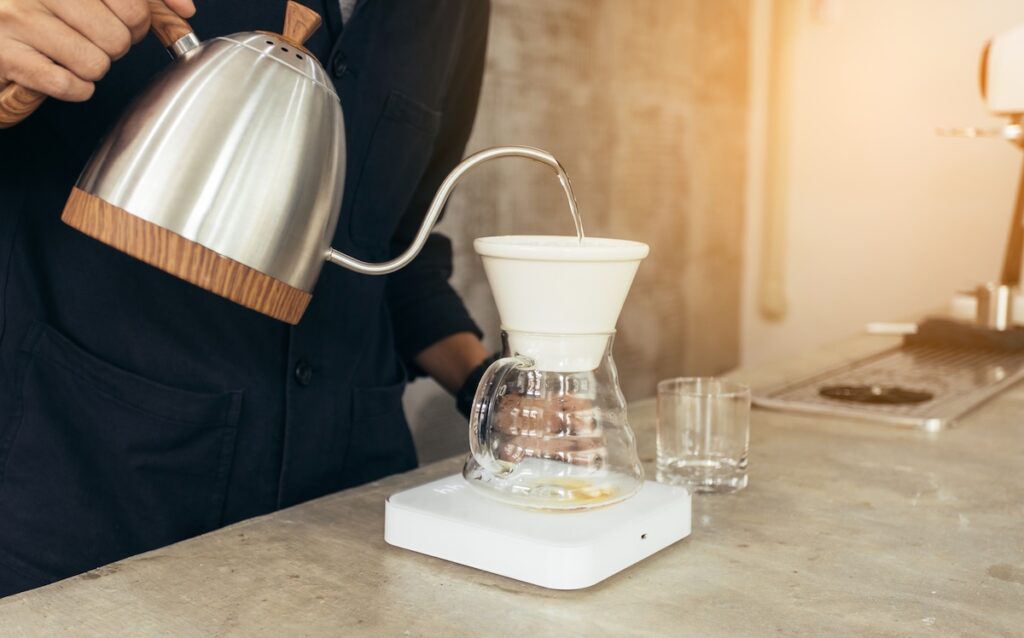
- Let it bloom. Wet the grounds with about 2 g of water for every 1 g of coffee and wait 30 to 40 seconds while they bubble, as Driftaway Coffee describes. That lets trapped gas escape so the water can extract properly.
- Pour the rest slowly in small circles, then pour the coffee into a small cup and keep it warm.
- Froth cold milk, then heat it. Cold milk takes in more air as smaller bubbles, and America’s Test Kitchen found that heating it after frothing sets the foam rather than flattening it. A handheld frother, a French press or a shaken jar all work, though ATK found the jar gives a slightly coarser foam.
- Heat it to 55 to 65°C (139 to 149°F), the Specialty Coffee Association’s range as Perfect Daily Grind reports it. Past about 70°C the milk starts to taste cooked.
- Pour the milk over the coffee and spoon the foam on top.
Keep it small. A cappuccino is a short drink with a thick cap of foam, and how big a cappuccino should be covers the classic size. Filling a mug with milk is how you end up with a latte that tastes of very little.
Why can’t a pour-over make espresso?
Because it’s nowhere near as concentrated. Methodical Coffee puts espresso at 1 part coffee to 2 parts water, against 14 to 16 for a normal pour-over, and espresso gets there by forcing water through very finely ground coffee under pressure. A pour-over only lets water drip through by gravity, so even at double strength it’s still a filter coffee.
That’s why the cup above won’t have crema, the golden foam on top of an espresso, and why less milk is the better fix than more coffee if your first attempt tastes weak.
Is a pour-over or a French press better for a cappuccino?
A French press, if you have both. Because the grounds sit in the water the whole time rather than draining through, it can make a much stronger brew from a small amount of water, which is closer to what a cappuccino needs. There’s a step-by-step version in making a cappuccino with a French press.
Pour-over gives you a cleaner cup with less sediment, so it’s worth using if it’s what you’ve got. Just expect a softer coffee flavor under the milk.
What is pour-over coffee?
It’s coffee made by pouring hot water by hand over ground coffee in a filter, so it drips through into a cup or carafe below. The method goes back to Melitta Bentz, a Dresden housewife who, as Europeana tells it, punched holes in a brass pot, lined it with blotting paper from her son’s school notebook, and patented the paper coffee filter in 1908.