(updated October 19th, 2026)
A good cappuccino is white on top with a ring of brown around the edge, carries a dome of foam that sits just above the rim of the cup, and has a surface so fine you can’t pick out individual bubbles. That’s close to word for word how the Istituto Espresso Italiano describes its certified cappuccino: white, “trimmed with a brown edge”, with foam of “a tight mesh with very fine or absent eye formation”. Cocoa on top is optional, and so is latte art.
So if yours arrives looking like a bubble bath, or a flat brown puddle, something went wrong before it reached you.
What Color Should Cappuccino Foam Be?
White, with a brown edge. The brown is the espresso showing at the rim where the foam meets the cup, and the Istituto Espresso Italiano says that edge can be “of various thickness”, so a thin ring and a wide one both count.
The one exception is a decorated cappuccino, where the barista pours a pattern into the top. Then you’ll see shapes “ranging from brown to hazelnut” against the white, which the same standard allows for. What you shouldn’t see is a top that’s brown or beige all over with no white in it. That means there’s very little foam sitting on the drink, which is the thing that makes a cappuccino a cappuccino.
How Thick Should Cappuccino Foam Be?
At least 1 cm, and it should stand slightly proud of the rim rather than sit below it. The Specialty Coffee Association sets that 1 cm as the minimum for a 150 to 180 ml cappuccino, as reported by Perfect Daily Grind. Some trainers go deeper: Melissa Caia of the William Angliss Institute’s Coffee Academy told the Sydney Morning Herald that she teaches 2 cm for a cappuccino.
So somewhere between 1 and 2 cm is right. You’ll still see “1 to 1.5 inches” quoted around the web, but that’s 2.5 to 4 cm, more foam than any of these standards asks for. There’s more on how much foam a cappuccino should have, and on why the cup is sized so the foam domes over the top.
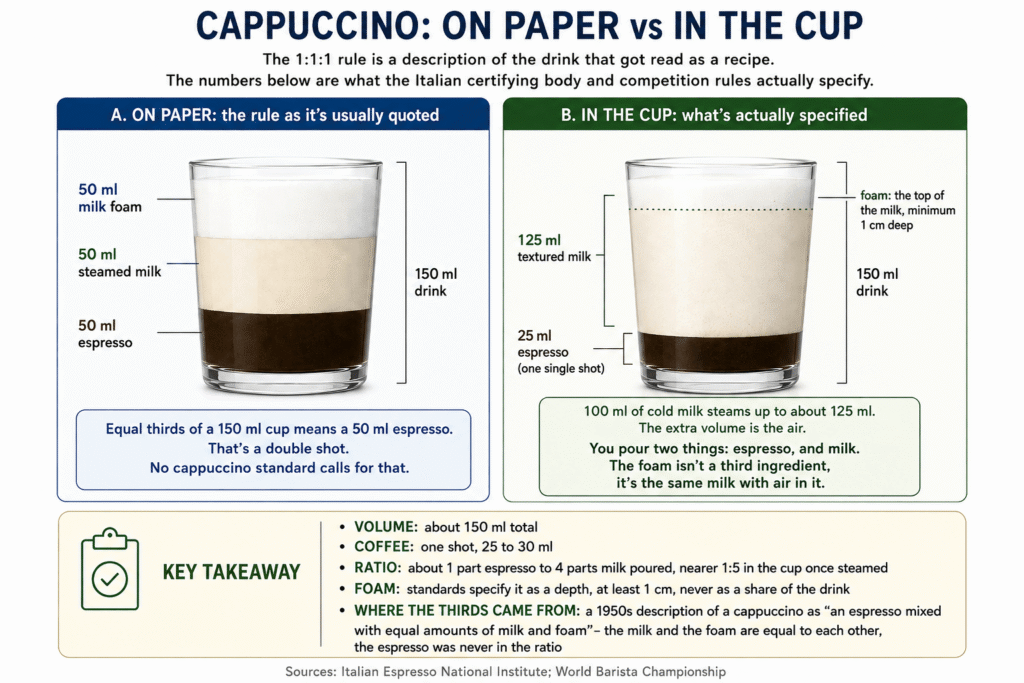
The foam isn’t a separate ingredient, either. A certified cappuccino is a single 25 ml espresso and 100 ml of milk, and the foam is that same milk with air worked into it as it steams. The milk grows from 100 ml to about 125 ml, so the whole drink comes to roughly 150 ml (per a University of Camerino doctoral thesis on the drink). The image below sets that against the “equal thirds” version you’ll often see, and there’s a fuller breakdown of the measurements here.
What Should The Texture Look Like Close Up?
Smooth, with no bubbles you can see. The Istituto Espresso Italiano’s phrase is “very fine or absent eye formation”, and “eyes” here means visible bubbles. Well-steamed milk also has a sheen to it. Clive Coffee describes it as milk that “looks like wet paint: no visible bubbles, a mirror-like sheen”.
A cappuccino does carry a deeper cap of foam than a latte, but deeper doesn’t mean coarser. Large bubbles, a dull or dry-looking surface, or foam that sits on the drink like a separate lid all point to milk that took on too much air, or wasn’t spun long enough to break the bubbles down. If that’s happening at home, the fix is at the steaming stage: see how long to steam milk for a cappuccino.
How Can You Tell It From A Latte Or Flat White?
Mostly by the foam and the cup. Perfect Daily Grind’s article gives today’s latte as 236 to 340 ml with about 0.5 cm of foam, while Caia’s teaching standard is 1 cm for a latte and “minimal foam on a flat white”. Side by side:
| Drink | Foam on top | Typical size |
|---|---|---|
| Cappuccino | At least 1 cm, up to 2 cm, domed above the rim | 150 to 180 ml |
| Latte | About 0.5 cm in today’s cafés (1 cm as a teaching standard) | 236 to 340 ml today |
| Flat white | Minimal | No agreed size |
A small cup with a tall white dome is a cappuccino. A bigger cup with a thin layer on top is a latte. There’s more on how a latte and a cappuccino differ beyond the look, and on the flat white too.
Does It Need Cocoa Or Latte Art On Top?
No. The plain version, white with a brown edge, is the classic one in the Italian standard, and when World Barista Championship judge Craig Dickson described the competition cappuccino to the Sydney Morning Herald in 2015, it was “served without chocolate”. A dusting of cocoa is a common café habit and a perfectly good one, but it’s an extra. If you want ideas, there’s a list of what you can put on top of a cappuccino.
Latte art is the same story. It shows the milk was steamed well enough to pour a pattern, which is a good sign, but a plain white top with a brown ring is every bit as correct.
A Quick Check For The Cup In Front Of You
Four things tell you a cappuccino looks the way it should:
- Color: white on top, brown ring at the edge (or a brown pattern, if it’s decorated).
- Height: foam at least 1 cm deep, standing just above the rim.
- Texture: no visible bubbles, and a slight shine.
- Size: a small cup, around 150 to 180 ml.
If I could only check one of those, I’d look at the bubbles. The width of the brown ring and the exact height within that 1 to 2 cm can vary from café to café and still be fine, but big bubbles usually mean the milk took on too much air, and they feel airy and dry in the mouth rather than creamy. That’s the part you’ll notice when you drink it.