(updated November 5th, 2026)
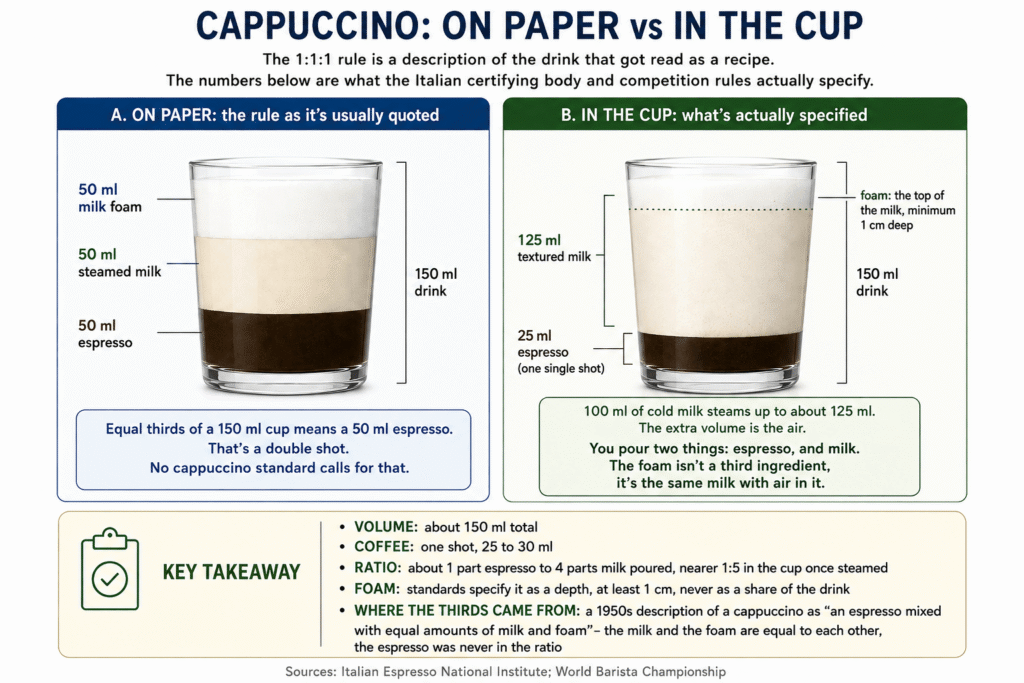
A cappuccino is around 150 ml, or roughly 5 fl oz. That’s the figure the Italian Espresso National Institute certifies back home in Italy: 25 ml of espresso topped with 100 ml of milk, steam-foamed until it grows to about 125 ml. That growth figure is recorded in a University of Camerino study of cappuccino foam. Add those together and you’ve got your 150 ml in the cup.
The Numbers At A Glance
Here’s a traditional cappuccino broken down, with the fluid ounces alongside.
| Part | ml | fl oz |
|---|---|---|
| Espresso (one shot) | 25 | 0.8 |
| Milk, before steaming | 100 | 3.4 |
| Milk, after steaming | about 125 | 4.2 |
| Finished drink | about 150 | 5 |
| Cup size | 150 to 180 | 5 to 6 |
Two Ingredients, Not Three
A cappuccino is built from just two things you pour: espresso and milk.
The foam isn’t a separate ingredient. It’s the same milk with air worked into it while you steam it, which is why 100 ml of cold milk comes out of the jug as roughly 125 ml. You never pour foam, you pour milk that’s been given a foam layer. Once that clicks, the “three equal parts” idea falls apart on its own, because two of those three parts were never separate to begin with.
Shot sizes do vary in practice. Plenty of shops outside Italy pull a 30 ml single or a 60 ml double, which is one reason the same drink comes out a different size depending on where you order it.
What Is The Cappuccino Ratio?
If you want a ratio rather than a volume, it’s about one part espresso to four parts milk. The Italian spec is 25 ml of espresso to 100 ml of milk. Steam that milk and it grows to roughly 125 ml, so in the finished cup you’re nearer one part coffee to five parts milk.
You’ll see the rule of thirds quoted far more often: equal parts espresso, steamed milk and foam. It’s a tidy idea, and it doesn’t survive the arithmetic. Equal thirds in a standard cup means 50 ml of espresso, which is a double shot, and that isn’t a cappuccino.
It also asks for something nobody measures. The standards set foam as a minimum depth, at least 1 cm, rather than a share of the drink, and no official standard sets a milk-to-foam ratio at all. James Hoffmann, in The World Atlas of Coffee, traces the rule of thirds to a 1950s description of a cappuccino as “an espresso mixed with equal amounts of milk and foam”. As Hoffmann points out, that’s ambiguous: it could mean all three parts are equal, or just the milk and the foam. Read it the second way and the espresso was never part of the ratio at all. This is how that looks side by side.
How Much Milk Is In A Cappuccino?
A cappuccino takes 100 ml of milk, which is about 3.4 fl oz, or a little under half a US cup. Steaming works air into it, so it leaves the jug at closer to 125 ml, about 4.2 fl oz, and that larger figure is what ends up in the cup.
That holds for a traditional cup. Order the same drink in a bigger one and the espresso usually stays at a shot or two, so the extra volume is milk. A 12 oz cappuccino isn’t a stronger drink than a 6 oz one, it’s a milkier one.
What Size Is A Standard Cappuccino?
Cup size is where most of the variation shows up. A cappuccino cup holds 150 to 180 ml, sized so the drink reaches the brim with its dome of foam on show. The Specialty Coffee Association defines a cappuccino as a 150 to 180 ml drink with a single shot and at least 1 cm of microfoam. Competition used the same numbers: in 2015, World Barista Championship judge Craig Dickson described a cappuccino as 30 ml of espresso with milk in a 150 to 180 ml cup, with judges pushing the foam back with a spoon to check that 1 cm. If you’re picking a cup rather than measuring the drink, here’s what size cappuccino cups are in ounces.
Chain coffee shops routinely serve larger than either standard, often adding a second shot to keep the coffee flavor forward rather than just adding more milk.
And personal taste counts for something. If you like it stronger, use less milk. If you want it creamier, use more. None of the standards are going to come after you.
So What Should You Aim For At Home?
Aim for a 150 to 180 ml cup and one shot of espresso, then steam enough milk to fill it. If you’re working with a bigger cup, add a second shot rather than more milk, otherwise you’ll dilute the coffee instead of scaling up the drink.